Monday, November 26, 2012

A changing of the guard


Collecting French stamps is most popular in France. While there are plenty of clubs and journals devoted to French philately in existence outside France, the center of gravity is in France, which is hardly surprising.

In Russian philately we are seeing the end of a long, unnatural period in which Russian philately was most intensively studied outside of Russia. While the Civil War and the 1920s saw a worldwide growth of interest in Russian philately, in the Soviet Union itself philately came to a screeching halt when stamp collectors were deemed to be suspicious characters because of their contacts with the outside world. Philatelists were purged along with everyone else during the Great Terror, and serious philately recovered only slowly, the appearance of a reborn “Soviet Collector” in the 1960s being the first sign that something was stirring again in the USSR.

In the meantime, Russian philately flourished outside Russia. After WW2 the BSRP started its long love affair with Russian philately, while yet another incarnation of the Rossica Society was founded in the USA. Other countries soon followed: Germany, France, Denmark, Sweden, Canada, Australia and New Zealand all had or have Russian philatelic societies.

But philatelists outside Russia were in a uniquely handicapped position. The lack of access to primary sources (e.g. postal archives) meant that Russian philately abroad developed as an “empirical” field. Outstanding postmark studies came into being simply by inventorying the material in our collections. Specialized stamp and postal history studies were based on material in collections, not on Goznak archives.

Tantalizing hints of what could be achieved with archive access came when the reborn Soviet Collector started publishing serious philatelic studies by Soviet philatelists. In the USA, the Library on Congress turned out to have a nice collection of official Russian publications as well, and in recent years Dr. Howard Weinert has used the interlibrary loan program as an impressive philatelic research tool. But the philatelic research achievements outside Russia have mostly been impressive because they were achieved at all, despite the handicap of having no or limited access to those all-important archives.

After the glasnost’ thaw, contacts between philatelists inside and outside the USSR intensified and we saw a flood of articles from serious philatelists inside the USSR appear in translation in Western journals. While 70+ years of active philatelic research had produced an immense mountain of knowledge in the West, seeing what access to archives could do was an eye-opener. While there were and are Western philatelists who combine intense study of their collections with archive research where this could be achieved, seeing nuggets of information unearthed from the archives of the Russian post and Goznak was and is wonderful.

Another big difference between philatelists inside and outside the former Soviet Union is their choice of subjects. Obviously, very few journals here in the West ever ran articles on “Lenin’s contribution to world peace through philately” or something like that, but even disregarding the obvious political differences, the Imperial and Civil War periods were far more popular in the West than the Soviet period, while the reverse seems to have been true in the USSR. And in Post-Soviet Russia? The Civil War is attracting growing interest, and the fine catalogs and handbooks now available for the Imperial period are signs that the pre-revolutionary period is more popular than ever before.

Demographics are another factor. The “Russian” philatelic societies in the West have an aging membership base, and it has become increasingly difficult to keep them going. It is not surprising that the Canadian Society of Russian Philately ceased publishing its very fine journal The Post-Rider, and the BSRP also had and has problems finding enough volunteers to do the inevitable work that keeps a society functioning.

Perhaps what we’re seeing is the end of an era: the end of a long period during which Russian philately flourished more outside Russia than inside Russia. The “Russian” philatelists in the West have done an outstanding job in keeping the field alive and well during the last 70 years, and have left a legacy of philatelic articles, books and exhibits that is now becoming available to an ever-increasing number of people through the internet. But the center of gravity may be shifting to Russia itself, where a new generation of philatelists is eagerly exploring a new world of philately. I think they’ll find the Western legacy to Russian philately a great basis for further expansion. We wish them well.

Wednesday, November 7, 2012

Nope, not buying it (literally)

The last White issue from the Crimea is the 100R surcharge on 1k Arms stamps. As is by now well known, these never saw use and left the Crimea in the luggage of the Whites' Evil Philatelist, Shredinskii. I've read references that Shredinskii also exported a Crimean postmark so he could concoct "used" copies, and I've seen (rather suspiciously clean) covers with 1919 dates that were identified by greater experts than me as Paris Products.
So when the cover below popped up on eBay I had to get past my initial impulse (Crimea! Civil War! 1920! Buy! Buy! Buy! Want!) and let sanity prevail.

This purports to be a letter from Sevastopol' to Yalta dated sometime in October 1920. It's a fake, in my opinion. The rate is wrong (should be 100R if it's after 15 October and 5R if it's before 15 October), no Yalta receiver (not impossible but uncommon, even for non-registered mail) and that postmark...
I collect Crimean postmarks and maintain a small database of information and pictures about them. This seems to be a legitimate postmark (SEVASTOPOL' TAVR.G. serial "k") but it seems to pop up a lot on faked covers...
So no. The cover went for a little over $100 - a price that is far too low if it were legitimate - so I think I'm not alone in disliking it...


Friday, October 5, 2012

The fate of Post-Soviet currencies

I blame Trevor Pateman, of course. While investigating modern Uzbekistan and Turkmenistan I was suddenly struck by the fact that the 15 Post-Soviet republics (not counting interesting breakaway areas like Transnistria and Abkhazia) have had a wide variety of monetary experiences since December 1991. All, at some point, abandoned the ruble, with Lithuania first (naturally) and Tadzhikistan last. Estonia has completely left the Post-Soviet sphere since adopting the Euro on 1 January 2011, but what's been happening in the other 14 republics? An overview, exchange rates as of today.

  • ARMENIA: 22 November 1993, 200 rubles = 1 dram. 1$ = 407 dram, 1R = 13 dram
  • AZERBAIJAN: 15 August 1992, 1 manat = 10 rubles; 1 January 2006, 1 new manat = 5000 manat. 1$ = 0.78 new manat, 1R = 0.025 new manat
  • BELARUS: May 1992, 1 Belarusian ruble = 10 rubles; 2000, 1 new ruble = 1000 Belarusian ruble. 1$ = 8570 new ruble, 1R = 277 new ruble
  • GEORGIA: 5 April 1993, 1 kupon lari = 1 ruble; 2 October 1995, 1 lari = 1000000 kupon lari. 1$ = 1.66 lari, 1R = 0.054 lari
  • KAZAKHSTAN: 15 November 1993, 1 tenge = 500 rubles. 1$ = 150 tenge, 1R = 4.85 tenge
  • KYRGYZSTAN: 10 May 1993, 1 som = 200 rubles. 1$ = 47 som, 1R = 1.52 som
  • LATVIA: 7 May 1992, 1 rublis = 1 ruble; 1993, 1 lats = 200 rublis. 1$ = 0.53 lats, 1R = 0.017 lats
  • LITHUANIA: August 1991, 1 talonas = 1 ruble; 25 June 1993, 1 litas = 100 talonas. 1$ = 2.65 litas, 1R = 0.086 litas
  • MOLDOVA: 1992, 1 cupon = 1 ruble; 29 november 1993, 1 moldovan leu = 1000 cupon. 1$ = 12.2 moldovan leu, 1R = 0.39 moldovan leu
  • RUSSIA: 1 January 1998, 1 new ruble = 1000 old rubles. 1$ = 31 new rubles
  • TADZHIKISTAN: 10 May 1995, 1 Tadzhik ruble = 100 rubles; 30 October 2000, 1 somoni = 1000 Tadzhik rubles. 1$ = 4.76 somoni, 1R = 0.15 somoni
  • TURKMENISTAN: 27 October 1993, 1 manat = 500 rubles; 1 January 2009, 1 new manat = 5000 manat. 1$ = 2.85 new manat, 1R = 0.092 new manat
  • UKRAINE: 10 January 1992, 1 karbovanets = 1 ruble; 16 September 1996, 1 hryvnia = 100000 karbovanets. 1$ = 8.11 hryvnia, 1R = 0.26 hryvnia
  • UZBEKISTAN: 15 November 1993, 1 som = 1 ruble; 1 July 1994, 1 new som = 1000 som. 1$ = 1942 new som, 1R = 62.7 new som.
Some interesting differences come to light if we express the current currencies of these republics in pre-1992 rubles, particularly looking at the exchange rates:
  • ARMENIA: 1 dram = 200 rubles. 1$ = 407 dram = 81.400 rubles
  • AZERBAIJAN: 1 new manat = 50000 rubles. 1$ = 0.78 new manat = 39.000 rubles
  • BELARUS: 1 new ruble = 10000 rubles. 1$ = 8570 new ruble = 85.700.000 rubles
  • GEORGIA: 1 lari = 1000000 rubles. 1$ = 1.66 lari = 1.660.000 rubles
  • KAZAKHSTAN: 1 tenge = 500 rubles. 1$ = 150 tenge = 75.000 rubles
  • KYRGYZSTAN: 1 som = 200 rubles. 1$ = 47 som = 9400 rubles
  • LATVIA: 1 lats = 200 rubles. 1$ = 0.53 lats = 106 rubles
  • LITHUANIA: 1 litas = 100 rubles. 1$ = 2.65 litas = 265 rubles
  • MOLDOVA: 1 moldovan leu = 1000 rubles. 1$ = 12.2 moldovan leu = 12.200 rubles
  • RUSSIA: 1 new ruble = 1000 old rubles. 1$ = 31.000 rubles
  • TADZHIKISTAN: 1 somoni = 100.000 rubles. 1$ = 4.76 somoni = 476.000 rubles
  • TURKMENISTAN: 1 new manat = 2.500.000 rubles. 1$ = 2.85 new manat = 7.125.000 rubles
  • UKRAINE: 1 hryvnia = 100000 rubles. 1$ = 8.11 hryvnia = 811.000 rubles
  • UZBEKISTAN: 1 new som = 1000 rubles.1$ = 1942 new som = 1.942.000 rubles
In general, the lower the latter number, the stronger the currency is, relative to the others. The differences are staggering! Belarus is clearly on some economic planet of its own and the relative strength of the Baltic states is clear. If I find the time I will track down domestic letter rates for the republics and express them in old rules, to demonstrate relative price differences since 1991.

Sunday, September 9, 2012

Philatelic historical research

As a collector of Russian Civil War material I am often confronted with the need to do research. Where and when were these stamps issued? Where were they used? Which postal rates were in force at the time? These are very basic questions that really require answers before you can really form an opinion about any item of postal history that comes your way.

In the absence of a handy archive of government publications (of which more later), there are roughly two methods of proceeding.

The first is what I call the empirical method: just gather as much information on used stamps and covers as you can, and hope that after a long time some patterns start to emerge. These days this approach is actually easier than it used to be. When I first started out investigating postal rates in Siberia, fellow collectors like Dr. Howard Weinert were kind enough to send me photocopies of all relevant items in their collections. Some dealers and auctions also added to the stack and I still have a giant pile of photocopies and clippings sitting in a drawer somewhere.

The coming of the internet has made all this a lot easier. Online auctions are a paradise for the data-hunter, but wariness is needed, as there is a lot of forged material out there that can screw up your dataset. Although when the patterns do start to emerge, forged material usually stands out like a sore thumb and  that can cause you to take a second look at that one cover that doesn't seem to fit any pattern.

The second approach is what I would call the historical approach. Study the history of the period and hope for some revelation to come to you while you're reading. I've never had much success with this approach myself.

It is worth stressing that both approaches give you at best "working hypotheses" as to what's going on. The only definitive answers come from primary sources: government archives or government publications. About 20 years ago, during the post-1991 thaw, it suddenly became possible to see the contents of some Russian archives online. It was a delightful discovery to find that the archive of Kolchak's government - including that of the postal administration! - had been quietly slumbering in  the State Archive of the Russian Federation. A kindly soul then provided me, years later, with photocopies of the circulars on postal rates. Hurrah! Problem solved.

Friday, September 7, 2012

The Big Numbers of Ukrainian stationery


In the former Soviet Union the use of postal stationery was far more ingrained than in the West. When, after decades of stability, prices and rates started going up, immense stocks of postal stationery had to be uprated or revalued by means of an overprint of some kind, as uprating with stamps was too cumbersome. In this way, a vast, decentralized program of overprinting stationery issues started, which only accelerated after Ukrainian independence in January 1992, when the Ukrainian economy went through an extended period of high inflation.

The number of different issues can only be guessed at. In two years 25 provinces, each with on average 20 issuing localities, went through 7 rate changes. In one city, Dnepropetrovsk, over 500 identifiable stationery issues came into being during this period, and this was no exception. 250,000 stationery issues for Ukraine as a whole seems about the right order of magnitude.

Think about that! Obviously. nobody will ever form a "complete" collection of this field. Nobody will ever write a definitive handbook for these issues. And yet again, this stuff is fairly cheap! What more could any philatelist with a sense of adventure want?

Wednesday, September 5, 2012

Fun with the 'Stans

Trevor Pateman's recent thoughts about post-Soviet Turkmenistan made me realize what an absolute blank spot on the map, philatelically, most of the post-Soviet republics are. Do a Google search for Azerbaijani stamps (let alone postal history) and you realize that there's almost nothing out there.
And the 5 Central Asian republics are the worst. Listings of the stamp issues can be found (for example the old WSRP website) but that's it. Postal history? Rates? Postmarks? Hah!
Spurred on by Trevor's blog I took a look at Turkmenistan. The country has mostly been in the news because of the baroque personality cult around its late president, Turkmenbashi (formerly Saparmurat Niyazov, who passed away, unlamented by many, in 2006). But a little digging shows you how much things have changed since 1991.

The old Soviet oblasti (provinces) have now been replaced by Turkish-sounding welayatlar, and placename changes are rife. Some are simple Turkmenizations (e.g. Ashgabat instead of Ashkabad, Turkmenabad instead of Chardzhui), or personality-cult madness (Krasnovodsk is now Turkmenbashi!). But the total effect is something that's very alien to us old Russia-collectors. One of the 5 welayatlar is the westernmost one, Balkan. Balkan? Yes, Balkan. The capital is, not unreasonably, Balkanabat which used to be called Nebit-Dag but not very often since this dreary stop on the Transcaspian railways wasn't built until 1933. So Krasnovodsk Oblast' and its capital Krasnovodsk are now Balkan Welayat with capital Balkanabat. And by the way, the latest postmarks I've seen actually mention the welayat in the postmark.

Stamp issues...Turkmenistan seems to have produced two types of stamp issues: definitive issues of truly epic ugliness, and mad personality-cult issues. Souvenir sheets with the face of Turkmenbashi were printed in formats that nearly exceeded the average album page size! Postal rates are unknown territory.

While getting material from Turkmenistan isn't exactly easy, there are a few new issue dealers out there who will get it for you (no doubt with expressions of great puzzlement) if you ask. My old friend Gurgen Vardanian (VarGur Stamps) in Lithuania is one of them. Non-philatelic covers have to be hunted down painstakingly in various online auctions. But everything's cheap! What more can a collector ask?


Saturday, August 11, 2012

A cover from Bessarabia’s “mystery period”


A quick poll will probably reveal that most readers know which 5 countries broke away from the Russian Empire (more-or-less) permanently after the Revolution: Poland, Finland and the 3 Baltic states. The fact that Bessarabia guberniya was quietly occupied and annexed by Romania in 1918 is less well known and the very few attempts at exploring what that meant in philatelic terms have all been within the pages of Yamshchik/The-Post-Rider. The political timeline was as follows (dates in New Style):
15 December 1917: “National Council” in Kishinev proclaims Moldavian People’s Republic, intended to be in a federative union with Russia
6 January 1918: military aid is requested from Romania
23 January 1918: Romanian units move into Bessarabia, occupying the following cities:
            24 January: Cahul
            25 January: Bolgrad
            26 January: Kishinev
            27 January: Reni
            3 February: Ismail
            5 February: Bendery
            7 February: Khilia
18 February 1918: total independence is declared
9 April 1918: Bessarabia is united with Romania
1 July 1918: Romanian postal service is established in Bessarabia
Clearly, the period of interest is from roughly 15 December 1917 to 1 July 1918: a period of transition, which is always interesting philatelically.


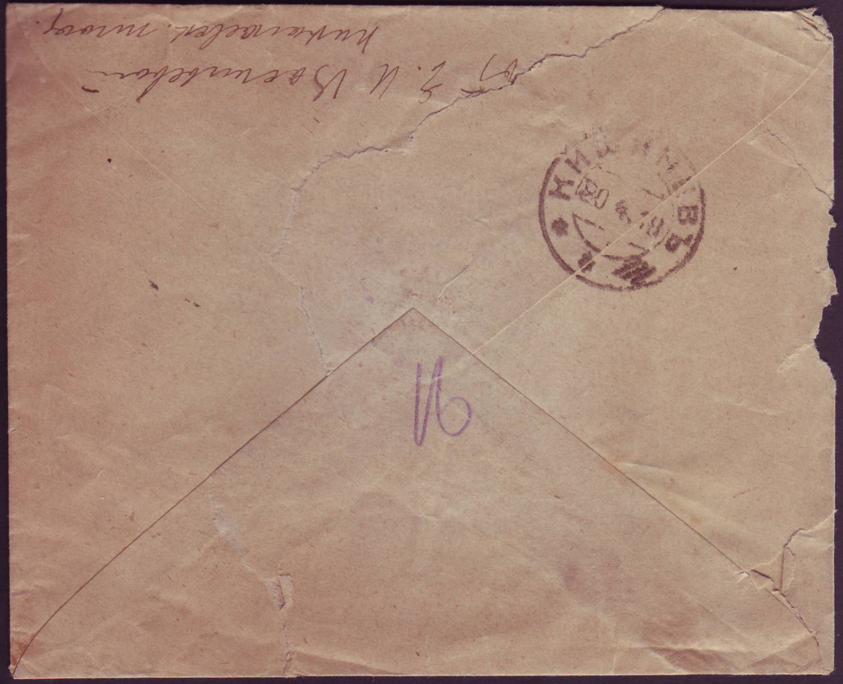
Sadly, examples of mail from this period are extremely scarce, and apart from two postcards described by Epstein (2005, 2007) I don’t know of any examples illustrated in the literature. So it’s a pleasure to add one more example to that short list. The cover illustrated here was sent registered from Bolgrad (17 April 1918) to Kishinev (20 April 1918). Franked with Russian Arms stamps for 50k, it supports Epstein’s conjecture that Moldavia-as-part-of-Romania was using the Ukrainian postal rates of 15 January 1918 (or something that looked just like it): 25k postage and 25k registration, see Ivakhno (1991) for details.


It’s an interesting example of Russian stamps being used to frank Ukrainian postal rates in what was by then part of Romania…

References
Epstein, Alexander: “An item from Bessarabia in the period of troubles”. Yamshchik/The Post-Rider 56, June 2005, pp.72-73.
Epstein, Alexander: “One more item of mail from Bessarabia in 1918”. Yamshchik/The Post-Rider 60, September 2007, pp.47-48.
Grecu, Dan: “The beginnings of the Romanian posts in Bessarabia in 1918”. Yamshchik/The Post-Rider 45, November 1999, pp.62-66.
Ivakhno, Aleksandr: “Pochtovye tarify Ukrainy 1918-1920gg”. Ukrainskaya i Rossiiskaya Filateliya 1, 1991, pp.7-13.