As a collector of Russian Civil War material I am often confronted with the need to do research. Where and when were these stamps issued? Where were they used? Which postal rates were in force at the time? These are very basic questions that really require answers before you can really form an opinion about any item of postal history that comes your way.
In the absence of a handy archive of government publications (of which more later), there are roughly two methods of proceeding.
The first is what I call the empirical method: just gather as much information on used stamps and covers as you can, and hope that after a long time some patterns start to emerge. These days this approach is actually easier than it used to be. When I first started out investigating postal rates in Siberia, fellow collectors like Dr. Howard Weinert were kind enough to send me photocopies of all relevant items in their collections. Some dealers and auctions also added to the stack and I still have a giant pile of photocopies and clippings sitting in a drawer somewhere.
The coming of the internet has made all this a lot easier. Online auctions are a paradise for the data-hunter, but wariness is needed, as there is a lot of forged material out there that can screw up your dataset. Although when the patterns do start to emerge, forged material usually stands out like a sore thumb and that can cause you to take a second look at that one cover that doesn't seem to fit any pattern.
The second approach is what I would call the historical approach. Study the history of the period and hope for some revelation to come to you while you're reading. I've never had much success with this approach myself.
It is worth stressing that both approaches give you at best "working hypotheses" as to what's going on. The only definitive answers come from primary sources: government archives or government publications. About 20 years ago, during the post-1991 thaw, it suddenly became possible to see the contents of some Russian archives online. It was a delightful discovery to find that the archive of Kolchak's government - including that of the postal administration! - had been quietly slumbering in the State Archive of the Russian Federation. A kindly soul then provided me, years later, with photocopies of the circulars on postal rates. Hurrah! Problem solved.
Sunday, September 9, 2012

Friday, September 7, 2012
The Big Numbers of Ukrainian stationery
In the former Soviet Union the use of postal stationery was far more
ingrained than in the West. When, after decades of stability, prices and rates
started going up, immense stocks of postal stationery had to be uprated or
revalued by means of an overprint of some kind, as uprating with stamps was too
cumbersome. In this way, a vast, decentralized program of overprinting stationery
issues started, which only accelerated after Ukrainian independence in January
1992, when the Ukrainian economy went through an extended period of high
inflation.
The number of different issues can only be guessed at. In two years 25
provinces, each with on average 20 issuing localities, went through 7 rate changes.
In one city, Dnepropetrovsk, over 500 identifiable stationery issues came into
being during this period, and this was no exception. 250,000 stationery issues for Ukraine as a whole seems about the right order of
magnitude.
Think about that! Obviously. nobody will ever form a "complete" collection of this field. Nobody will ever write a definitive handbook for these issues. And yet again, this stuff is fairly cheap! What more could any philatelist with a sense of adventure want?
Wednesday, September 5, 2012
Fun with the 'Stans
Trevor Pateman's recent thoughts about post-Soviet Turkmenistan made me realize what an absolute blank spot on the map, philatelically, most of the post-Soviet republics are. Do a Google search for Azerbaijani stamps (let alone postal history) and you realize that there's almost nothing out there.
And the 5 Central Asian republics are the worst. Listings of the stamp issues can be found (for example the old WSRP website) but that's it. Postal history? Rates? Postmarks? Hah!
Spurred on by Trevor's blog I took a look at Turkmenistan. The country has mostly been in the news because of the baroque personality cult around its late president, Turkmenbashi (formerly Saparmurat Niyazov, who passed away, unlamented by many, in 2006). But a little digging shows you how much things have changed since 1991.
The old Soviet oblasti (provinces) have now been replaced by Turkish-sounding welayatlar, and placename changes are rife. Some are simple Turkmenizations (e.g. Ashgabat instead of Ashkabad, Turkmenabad instead of Chardzhui), or personality-cult madness (Krasnovodsk is now Turkmenbashi!). But the total effect is something that's very alien to us old Russia-collectors. One of the 5 welayatlar is the westernmost one, Balkan. Balkan? Yes, Balkan. The capital is, not unreasonably, Balkanabat which used to be called Nebit-Dag but not very often since this dreary stop on the Transcaspian railways wasn't built until 1933. So Krasnovodsk Oblast' and its capital Krasnovodsk are now Balkan Welayat with capital Balkanabat. And by the way, the latest postmarks I've seen actually mention the welayat in the postmark.
Stamp issues...Turkmenistan seems to have produced two types of stamp issues: definitive issues of truly epic ugliness, and mad personality-cult issues. Souvenir sheets with the face of Turkmenbashi were printed in formats that nearly exceeded the average album page size! Postal rates are unknown territory.
While getting material from Turkmenistan isn't exactly easy, there are a few new issue dealers out there who will get it for you (no doubt with expressions of great puzzlement) if you ask. My old friend Gurgen Vardanian (VarGur Stamps) in Lithuania is one of them. Non-philatelic covers have to be hunted down painstakingly in various online auctions. But everything's cheap! What more can a collector ask?
And the 5 Central Asian republics are the worst. Listings of the stamp issues can be found (for example the old WSRP website) but that's it. Postal history? Rates? Postmarks? Hah!
Spurred on by Trevor's blog I took a look at Turkmenistan. The country has mostly been in the news because of the baroque personality cult around its late president, Turkmenbashi (formerly Saparmurat Niyazov, who passed away, unlamented by many, in 2006). But a little digging shows you how much things have changed since 1991.
The old Soviet oblasti (provinces) have now been replaced by Turkish-sounding welayatlar, and placename changes are rife. Some are simple Turkmenizations (e.g. Ashgabat instead of Ashkabad, Turkmenabad instead of Chardzhui), or personality-cult madness (Krasnovodsk is now Turkmenbashi!). But the total effect is something that's very alien to us old Russia-collectors. One of the 5 welayatlar is the westernmost one, Balkan. Balkan? Yes, Balkan. The capital is, not unreasonably, Balkanabat which used to be called Nebit-Dag but not very often since this dreary stop on the Transcaspian railways wasn't built until 1933. So Krasnovodsk Oblast' and its capital Krasnovodsk are now Balkan Welayat with capital Balkanabat. And by the way, the latest postmarks I've seen actually mention the welayat in the postmark.
Stamp issues...Turkmenistan seems to have produced two types of stamp issues: definitive issues of truly epic ugliness, and mad personality-cult issues. Souvenir sheets with the face of Turkmenbashi were printed in formats that nearly exceeded the average album page size! Postal rates are unknown territory.
While getting material from Turkmenistan isn't exactly easy, there are a few new issue dealers out there who will get it for you (no doubt with expressions of great puzzlement) if you ask. My old friend Gurgen Vardanian (VarGur Stamps) in Lithuania is one of them. Non-philatelic covers have to be hunted down painstakingly in various online auctions. But everything's cheap! What more can a collector ask?
Saturday, August 11, 2012
A cover from Bessarabia’s “mystery period”
A quick poll will probably reveal that most readers know
which 5 countries broke away from the Russian Empire (more-or-less) permanently
after the Revolution: Poland, Finland and the 3 Baltic states. The fact that
Bessarabia guberniya was quietly occupied and annexed by Romania in 1918 is
less well known and the very few attempts at exploring what that meant in
philatelic terms have all been within the pages of Yamshchik/The-Post-Rider. The political timeline was as follows
(dates in New Style):
15 December
1917: “National Council” in Kishinev proclaims Moldavian People’s Republic,
intended to be in a federative union with Russia
6 January 1918: military aid is
requested from Romania
23 January 1918: Romanian units
move into Bessarabia, occupying the following cities:
24
January: Cahul
25
January: Bolgrad
26
January: Kishinev
27
January: Reni
3
February: Ismail
5
February: Bendery
7
February: Khilia
18 February 1918: total
independence is declared
9 April 1918: Bessarabia is united
with Romania
1 July 1918: Romanian postal
service is established in Bessarabia
Clearly, the period of interest is from roughly 15 December
1917 to 1 July 1918: a period of transition, which is always interesting
philatelically.

Sadly, examples of mail from this period are extremely
scarce, and apart from two postcards described by Epstein (2005, 2007) I don’t
know of any examples illustrated in the literature. So it’s a pleasure to add
one more example to that short list. The cover illustrated here was sent
registered from Bolgrad (17 April 1918) to Kishinev (20 April 1918). Franked
with Russian Arms stamps for 50k, it supports Epstein’s conjecture that
Moldavia-as-part-of-Romania was using the Ukrainian postal rates of 15 January
1918 (or something that looked just like it): 25k postage and 25k registration,
see Ivakhno (1991) for details.
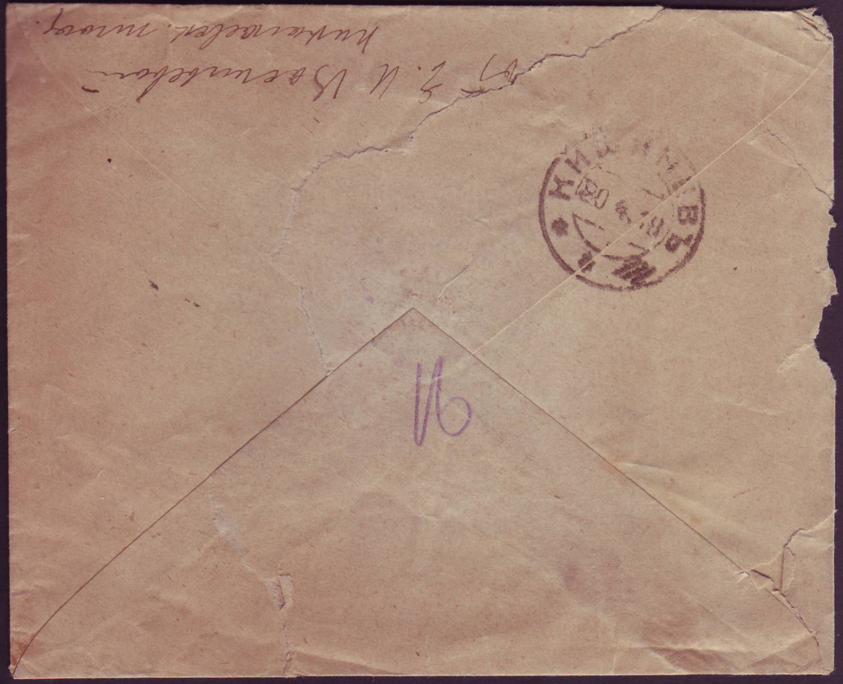
It’s an interesting example of Russian stamps being used to
frank Ukrainian postal rates in what was by then part of Romania…
References
Epstein, Alexander: “An item from Bessarabia in the period
of troubles”. Yamshchik/The Post-Rider 56,
June 2005, pp.72-73.
Epstein, Alexander: “One more item of mail from Bessarabia
in 1918”. Yamshchik/The Post-Rider 60,
September 2007, pp.47-48.
Grecu, Dan: “The beginnings of the Romanian posts in Bessarabia
in 1918”. Yamshchik/The Post-Rider
45, November 1999, pp.62-66.
Ivakhno, Aleksandr: “Pochtovye tarify Ukrainy 1918-1920gg”. Ukrainskaya i Rossiiskaya Filateliya 1,
1991, pp.7-13.
Sunday, June 10, 2012
In praise of the obscure and unpopular
For literally decades, Russia was the only thing I collected. Siberia, Crimea, Georgia, prestamp, lots of other things, all within the vast field of Russian philately. But as we all know, the 21st century saw an unprecedented explosion in the prices of most Russian material.
My good friend Robert Taylor has for many years collected Russian/Soviet postal history, but he also collects Nicaragua. After seeing the fun he has with that, I decided to take a Latin American philatelic mistress as well, and after lots of research settled on Paraguay. Post-WW2 Paraguay is pretty icky. Not only is there the political unpleasantness of the Stroessner regime, the philatelic pandering was blatant and off-putting. I mean, Paraguay issued "Europa" stamps!
19th century Paraguay has other problems. Prior to 1870 the country was essentially destroyed completely and started over from scratch. The first few issues are all but impossible to find on cover and it's not until the late 1880s that Paraguayan covers become obtainable. So after some thought I decided to pick the 1900-1945 period as my playing field.
It was a revelation! If I have more than 2 competitors for any Paraguayan eBay lot I am shocked! I don't know of any other serious Paraguay collectors in the USA, and even worldwide they seem to be thin on the ground. As a result, material - even rare or unique material - is CHEAP! I've bought absolutely unique items for a few hundred dollars at most. Proofs and essays, which I've always liked, are common for some issues and just scarce enough for others to make it interesting. And postal history seems to be a largely unexplored field. What more can any collector want?
Even in the Russian field there are such lovely little playgrounds. Post-Soviet material (say, up to 1995) is invariably interesting, and quite scarce from some countries (I'm looking at you, Georgia), although you do have to educate yourself to be able to spot the numerous forgeries and fantasy products. hey, I'm a Russian Civil War philatelic veteran, that sort of thing doesn't scare me!
Think about it. Tired of being outbid? Go weird!
My good friend Robert Taylor has for many years collected Russian/Soviet postal history, but he also collects Nicaragua. After seeing the fun he has with that, I decided to take a Latin American philatelic mistress as well, and after lots of research settled on Paraguay. Post-WW2 Paraguay is pretty icky. Not only is there the political unpleasantness of the Stroessner regime, the philatelic pandering was blatant and off-putting. I mean, Paraguay issued "Europa" stamps!
19th century Paraguay has other problems. Prior to 1870 the country was essentially destroyed completely and started over from scratch. The first few issues are all but impossible to find on cover and it's not until the late 1880s that Paraguayan covers become obtainable. So after some thought I decided to pick the 1900-1945 period as my playing field.
It was a revelation! If I have more than 2 competitors for any Paraguayan eBay lot I am shocked! I don't know of any other serious Paraguay collectors in the USA, and even worldwide they seem to be thin on the ground. As a result, material - even rare or unique material - is CHEAP! I've bought absolutely unique items for a few hundred dollars at most. Proofs and essays, which I've always liked, are common for some issues and just scarce enough for others to make it interesting. And postal history seems to be a largely unexplored field. What more can any collector want?
Even in the Russian field there are such lovely little playgrounds. Post-Soviet material (say, up to 1995) is invariably interesting, and quite scarce from some countries (I'm looking at you, Georgia), although you do have to educate yourself to be able to spot the numerous forgeries and fantasy products. hey, I'm a Russian Civil War philatelic veteran, that sort of thing doesn't scare me!
Think about it. Tired of being outbid? Go weird!
 |
| Presentation card with color proofs for the second Paraguay 1903 definitive issue |
Saturday, June 9, 2012
Collecting postmarks
Collecting postmarks is an odd little sub-hobby of postal history. In a way, it ignores almost all the interesting bits about postal history (routes, rates, mail types, etc.) and focuses on the markings that are only of indirect interest.
That said, it's a lot of fun! I'd argue that it's often the most natural expansion of a stamp collection, to move into collecting the postmarks on the stamps. Since postmarks on loose stamps can be frustrating, it's often easier and more rewarding to collect postmarks on complete items of mail.
Oversimplifying recklessly, I think you can collect postmarks in four ways: by location, period, type or usage. Location and period are fairly self-explanatory while "type" can be as simple as "oval" or as complicated as "locally produced nonstandard datestamps of the late Imperial Russian period" (and if you collect the latter then good luck - they're fascinating and very, very scarce). "Usage" is the least popular category and includes perfectly boring-looking postmarks used by seasonal post offices. It's often an indirect way to define "type".
As I may have mentioned once or twice, I collect postmarks from the Crimea, pre-stamp to 1945. The late Imperial (1903-1917) and early Soviet (1923-1939) periods are by far the most interesting to me. In the late Imperial period, three classes of Crimean postmarks are a particular headache to find.
Railways post offices include the two Zh.D.P.O.-class offices of Sevastopol' (common) and Kerch' (rare); three stantsiyas which were converted to ordinary P.O.s fairly soon after their opening (Nikita, Sarabuz and Sem' Kolodezei - I've only seen the latter); and regular stantsiya offices. I had never seen a Crimean stantsiya postmark until fairly recently, when a Soviet late usage of the Imperial postmark of Akmanai found its way into my collection.
The second class of "difficult" postmarks are the seasonals. Livadiya is the oldest and the most common.Six new seasonal offices were opened in 1915: Isary, Koktebel', Moinak, Otuzskiya Dachi, Sara-Kurort and Chokrak, of which Sara-Kurort was converted to a regular P.O. in 1916. The last to be added was Sudakskiya Dachi in 1917. Sadly, Evpatoriiskiya Dachi, despite its summer-y name, was not a seasonal office.
The final class of problem cases are the "Volostnoe Pravlenie" offices. There were 9 of them, of which 6 were converted to P.O.s in 1916 I have yet to see a postmark of any of them...
That said, it's a lot of fun! I'd argue that it's often the most natural expansion of a stamp collection, to move into collecting the postmarks on the stamps. Since postmarks on loose stamps can be frustrating, it's often easier and more rewarding to collect postmarks on complete items of mail.
Oversimplifying recklessly, I think you can collect postmarks in four ways: by location, period, type or usage. Location and period are fairly self-explanatory while "type" can be as simple as "oval" or as complicated as "locally produced nonstandard datestamps of the late Imperial Russian period" (and if you collect the latter then good luck - they're fascinating and very, very scarce). "Usage" is the least popular category and includes perfectly boring-looking postmarks used by seasonal post offices. It's often an indirect way to define "type".
As I may have mentioned once or twice, I collect postmarks from the Crimea, pre-stamp to 1945. The late Imperial (1903-1917) and early Soviet (1923-1939) periods are by far the most interesting to me. In the late Imperial period, three classes of Crimean postmarks are a particular headache to find.
Railways post offices include the two Zh.D.P.O.-class offices of Sevastopol' (common) and Kerch' (rare); three stantsiyas which were converted to ordinary P.O.s fairly soon after their opening (Nikita, Sarabuz and Sem' Kolodezei - I've only seen the latter); and regular stantsiya offices. I had never seen a Crimean stantsiya postmark until fairly recently, when a Soviet late usage of the Imperial postmark of Akmanai found its way into my collection.
 |
| Sem' Kolodezei as a P.O. |
 |
| Otuzskiya Dachi Seasonal office |
Sunday, October 2, 2011
Some thoughts about the Schlegel "Russia" sale
Schlegel is an auction house in Berlin that recently had a wonderful Russia sale: all postal history, from all periods.
There was some wonderful stuff in there, and I'm very pleased I got the one lot I bid on. Other lots were nice but overpriced. For example, there were half a dozen Imperial international money orders from Karasubazar, Crimea. Very unusual, but at 65 Euros a pop they'd have been around $125 each by the time they'd reached me and that was just too much. They didn't sell.
TPO collectors had a lot of fun with this sale too, a s the TPO marks were split over many smaller lots. That enabled the informed buyers to cherry-pick, and as a result the less attractive lots remained unsold.
In general, the bidders were obviously an informed lot. Azerbaijan had lots of average covers, many of which remained unsold, but for the good items there was spirited bidding, so bidders obviously knew what to look for.
In all, I think about two-thirds of the lots remained unsold. I hope this result won't discourage further sales like this!
There was some wonderful stuff in there, and I'm very pleased I got the one lot I bid on. Other lots were nice but overpriced. For example, there were half a dozen Imperial international money orders from Karasubazar, Crimea. Very unusual, but at 65 Euros a pop they'd have been around $125 each by the time they'd reached me and that was just too much. They didn't sell.
TPO collectors had a lot of fun with this sale too, a s the TPO marks were split over many smaller lots. That enabled the informed buyers to cherry-pick, and as a result the less attractive lots remained unsold.
In general, the bidders were obviously an informed lot. Azerbaijan had lots of average covers, many of which remained unsold, but for the good items there was spirited bidding, so bidders obviously knew what to look for.
In all, I think about two-thirds of the lots remained unsold. I hope this result won't discourage further sales like this!
Subscribe to:
Comments (Atom)